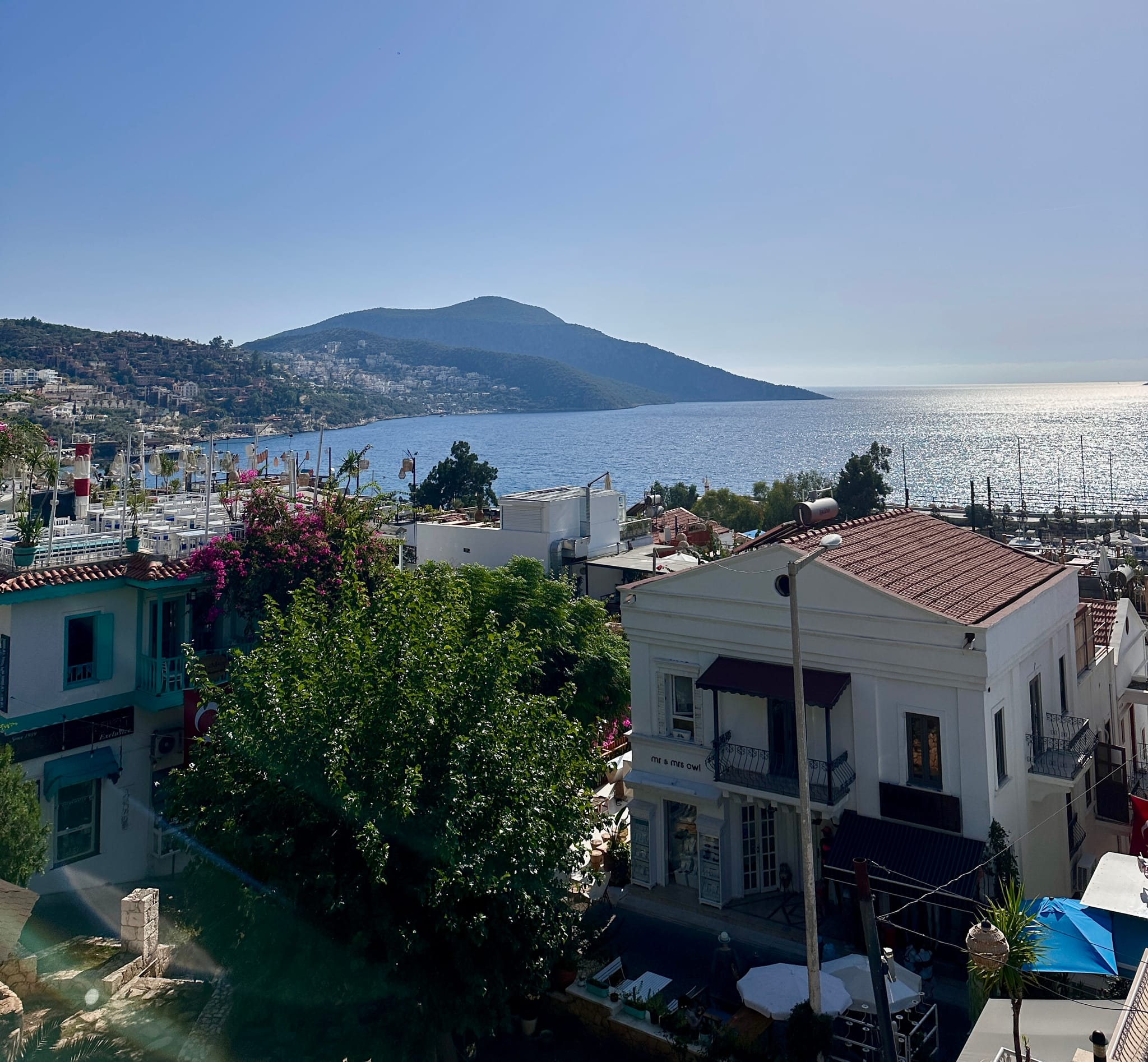
Ask when to visit Kalkan and the honest answer has three parts. For warm sea with very little rain, aim for late May to the end of June, or for September into early October. For the hottest, driest weather of the year, with nights that never really cool, it is July and August. From November to March the town is mild by northern European standards and genuinely wet, and most guides simply stop mentioning those months. This one does not: below are all twelve months, with air and sea temperatures and a rainfall figure for every single one, which is the part almost every guide leaves out.
Kalkan month by month
One table, twelve rows. The air temperatures and rainfall are long-run averages from the nearest long-record station, at Kaş on the same stretch of coast, and the sea temperatures are best estimates rather than buoy readings, which is why they appear as whole degrees.
| Month | Air high / sea (°C) | Rainfall (mm) |
|---|---|---|
| January | 15.9 / 17 | 179.1 |
| February | 16.1 / 17 | 122.8 |
| March | 18.1 / 17 | 74.8 |
| April | 21.1 / 17 to 18 | 40.6 |
| May | 25.2 / 20 | 15.8 |
| June | 29.5 / 23 | 2.5 |
| July | 32.5 / 26 | 0.9 |
| August | 32.9 / 28 | 0.2 |
| September | 30.2 / 27 | 14.7 |
| October | 26.3 / 24 | 74.1 |
| November | 21.8 / 21 | 111.3 |
| December | 17.5 / 19 | 197.3 |
Three things stand out. The summer drought is real: from June to September, rain more or less stops. December and January are properly wet, far wetter than most first-time visitors expect of the Mediterranean region. And the sea lags the air by about a month, which is why the swimming is so much better in September than in May, even though the two months sit at similar points in the season.
How wet Kalkan actually is
Kalkan sits on a Mediterranean coast with a genuine wet season, and the only reason it has a reputation as a dry place is that most visitors only ever see the summer half of the table. Across a full year, the station normals record 834.1 mm of rain, and an independent dataset built from a different station and a different method arrives at 829 mm. Two separate totals landing within about half a percent of each other is about as settled as climate data gets, so this is not a marginal call. Put plainly, the annual total here is higher than London's, a comparison that surprises nearly everyone who hears it. The difference is the shape of the year, not the amount: Kalkan concentrates almost all of its rain between November and March, then goes months at a stretch with essentially none. If you are travelling between June and September, the wet season belongs to a version of the coast you would barely recognise. If you are weighing a winter stay, take the December and January rows at face value. One thing we will not pretend to know: you will not find a rainy-day count on this page, because the two available sources disagree substantially on how to count one, and we would rather publish nothing than a number we cannot stand behind.
How hot July and August really get
These are the hottest and driest months of the year, and the highs in the table are not the part that needs a caveat. The caveat is the nights. The mean daily minimum is 25.1°C in July and 25.7°C in August, which means the evening never really cools: you eat dinner in the warmth, and you will want air conditioning, or at least a well-shaded bedroom, to sleep properly. Rain is effectively absent, 0.9 mm in July and 0.2 mm in August, so a washed-out day is not something you need to plan around. The sea climbs from around 26°C to around 28°C, its warmest of the year. The trick is to pace the day rather than avoid these months: shade and water matter more than anything else, so keep walks and ruins for early morning, give the middle of the day to the pool and a long lunch, and save the town for the evening.
Who July and August still suit
Anyone whose holiday is built around the water: swimmers, boat-trip devotees, families who want the certainty of a dry fortnight, and people who genuinely love heat. If your ideal day instead involves long walks, unhurried sightseeing, or sleeping with the windows open, the shoulder months below will treat you better.
The shoulder months: May, June, September and October
This is where most guests land, and the variable that should decide between these months is not the air, it is the sea. The air warms quickly in spring; the sea does not. In May the water is still around 20°C against an air high of 25.2°C: bracing swims, superb walking weather. In September the position reverses, with the sea holding around 27°C against a 30.2°C high, so you get high-summer swimming with the fiercest heat gone. Evenings tell the same story: a mean minimum of 17.9°C in May against 23.0°C in September is the difference between wanting a light layer at dinner and not thinking about it. June is the bridge month, with the sea reaching around 23°C just as the rain all but stops. If you are torn between the two classic shoulder picks, we weigh May vs September in detail. October is the month the year turns: the sea is still around 24°C, warm enough for a swim every day, but rainfall returns at 74.1 mm, so expect a few wet days and plan something for them. Evenings stay comfortable, with a mean minimum of 19.6°C. There is more to the month than its weather row, and we cover it properly in Kalkan in October.
What November to March are actually like
Mild by northern European standards, wet by any standard. Daytime highs run from 15.9°C to 21.8°C across the five months, so a sunny winter afternoon here can be genuinely pleasant outdoors. The nights are another matter: mean minima of 9.2°C in January and 11.0°C in December mean you will want heating rather than a terrace. The sea sits at 17 to 21°C, which is cold-water swimming rather than holiday swimming, and the rain peaks sharply, at 197.3 mm in December and 179.1 mm in January. A winter stay can work well taken on its own terms, and a pool you can actually use changes the equation: see our villas with heated pools. For the full picture of what those months feel like, we cover it in Kalkan in winter.
Where these numbers come from
The air temperatures and rainfall are climate normals: long-run monthly averages for the period 1991 to 2020, recorded at the nearest long-record station, which is at Kaş, about 25 km along the same coast. Kalkan has no long-record station of its own. The sea temperatures are different in kind: no station or buoy measures the water here, so the values are where three separate estimates, each worked out a different way, agree, which is why they are given in whole degrees rather than to a decimal. And normals are averages. An individual afternoon can run hotter than its month's high, and a single week can be wetter than the monthly total suggests. The table tells you what a month is like, not what your week will be.
Choosing a villa for the month you pick
The month you choose changes what to look for in the villa. In May, June and October, pool warmth is the difference between a pool you look at and a pool you live in, so ask about heating before you shortlist. In July and August, shade, cross-ventilation and generous indoor living space matter more than anything on the terrace. Browse our Kalkan villas with your month in mind, and if your real question is when to book rather than when to go, that has its own guide.
Common questions
Is May or September the better shoulder month?
For swimming, September, and it is not close: the sea holds around 27°C against May's around 20°C. May answers back with cooler walking weather and the whole summer still ahead of it. The full comparison lives in May vs September in detail.
What is Kalkan like in October?
Warm days with an air high of 26.3°C, a sea still around 24°C, and the return of real rainfall at 74.1 mm across the month. Pack for daily swims and the occasional wet day in the same bag. We cover the month fully in Kalkan in October.
Is Kalkan worth visiting between November and March?
Yes, if you take it on its own terms: mild days, a sea too cold for most swimmers, and genuinely heavy rain in December and January. It is a different holiday from summer, not a lesser one. Kalkan in winter covers what that looks like in practice.
Do we need a villa with a heated pool, and in which months?
From November to April the sea sits at 17 to 21°C and an unheated pool will not be any warmer, so heating decides whether you swim at all. From June to September it is unnecessary. May and October sit in between, and a heated pool earns its keep in both: browse villas with heated pools if your dates fall there.
Related reading: for planning the shape of your Kalkan year beyond the weather, see the quiet weeks.