No, you do not need a car for a town-based stay in Kalkan. You might want one if your villa sits in a hill village, if you plan independent day trips to places such as Saklıkent, if anyone in your group has limited mobility, or if you are travelling outside summer when the dolmuş, the shared local minibus, thins out. Everything else, the hills included, can be managed on foot, with the taxi rank and a pocket of lira.
The short answer, and the honest exceptions
Ask the people who are not selling anything and the verdict is consistent: taxis are plentiful, much of the town is walkable, and a car is optional for a stay based in Kalkan itself. The voices arguing hardest for a hire car tend to be the companies hiring them out. Canvilia sells villa holidays, not cars, so we can afford to be straight about it.
The exceptions deserve equal honesty:
- A hill-village villa. Kördere, İslamlar, Bezirgan, Üzümlü and Kışla all sit above or outside the town, and staying there means a car or a standing taxi arrangement.
- Independent day trips. Saklıkent Gorge and Tlos are not easily reached by public transport, and a Patara-heavy week is far easier with your own wheels.
- Limited mobility. The town's steps and slopes make door-to-door transport the practical choice; more on this below.
- An off-season stay. Dolmuş services thin considerably in winter, which shifts the balance back towards four wheels.
Getting here from the airport is a separate question, answered in our guide to airport transfers.
Kalkan transport at a glance
If you are the one settling the car argument for your whole group, this is the table to send round.
| Mode | Best for | The catch |
|---|---|---|
| Walking | The old town, the harbour and dinner, all downhill | Steep streets and steps; the climb back up at night is the hard part |
| Taxi | The ride back up the hill and door-to-door trips at night | Book ahead off-season; hill villages and out-of-town runs cost noticeably more |
| Dolmuş | Kaputaş, Kaş and Patara without a car | A steep walk up to the boarding point; cash only; thinner service in winter |
| Water taxi | Reaching the beach clubs from the harbour | A beach-club shuttle, not a bus; no timetables, and what runs varies by month and weather |
| Hire car | Hill-village villas, Saklıkent and Tlos days, a Patara-heavy week | Narrow streets and tight parking; book several days ahead in high season |
The hills: walk down, taxi back
Kalkan is a steep hillside town, and the slope shapes every evening. The pattern locals and returning guests describe is simple: walk down through Kalkan old town to the harbour for dinner, then take a taxi back up. In high summer even committed walkers call the climb home too hot and steep at night.
Two honest notes. First, there is no step-free route between the upper town and the harbour; expect steps and gradient throughout. Second, how much the hills matter is largely decided the day you choose where to stay. A villa near the flat heart of town turns the whole question into a short stroll, which is exactly what our villas within walking distance of town are for.
Taxis: ranks, booking and what they cost, roughly
The main rank sits at the roundabout at the top of the old town, with further pickup points and taxi call buttons at the harbour end and by several supermarkets. Booking is refreshingly low-tech: hail a cab, walk to the rank, or arrange one by phone or WhatsApp. Drivers hand out cards and are happy to take scheduled pickups, so many guests simply message their regular driver each evening. You can ask for a woman driver locally, and there is no taxi app in Kalkan.
Taxis run late in season; off-season, book ahead rather than counting on a passing cab. On cost, short hops within the resort are inexpensive, while runs up to the hill villages or out of town cost noticeably more, so a hill-village villa means treating taxis as a real line in the budget.
The dolmuş: routes, boarding and paying
Kalkan's dolmuş routes, which stitch this coast together, all start at the otogar, the small bus terminus above town, and pass through Kalkan along Şehitler Caddesi. Reaching a boarding point means a steep walk up from the old town; it takes anywhere from about ten to about twenty-five minutes depending on where you start, so allow time.
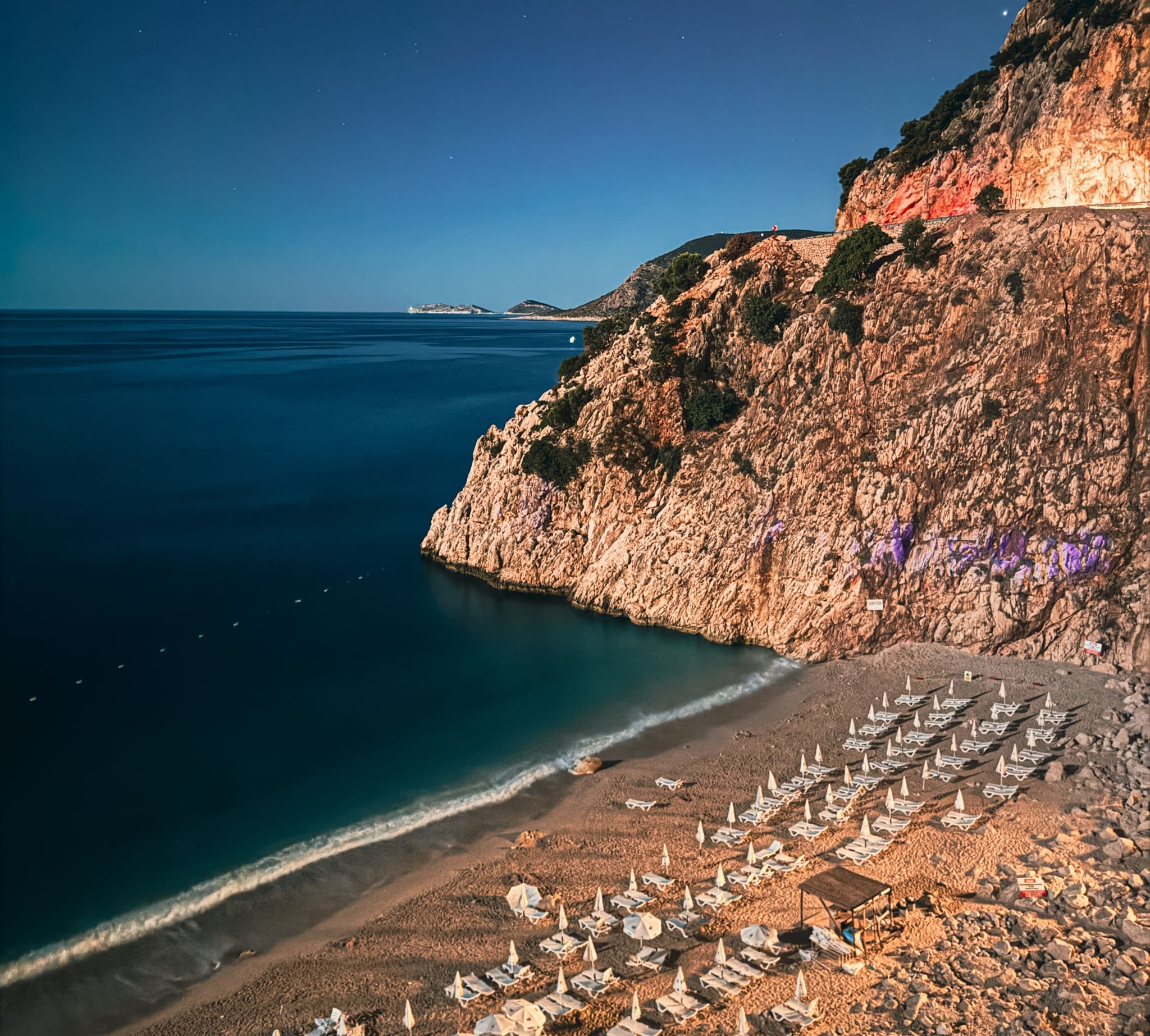
Southbound, the route runs from the otogar through town to Kaş in about 30 minutes, passing Kaputaş beach on the way. It stops there on request, so tell the driver you want Kaputaş. Northbound for Patara, expect either a direct run via Gelemiş or a change at the main-road junction; either way, one ticket covers the whole trip and there is nothing to pay again.
Payment is cash, in Turkish lira, handed over on board, and change is given. Frequency is the one thing not to plan around too precisely: roughly half-hourly in season, with timings that can be erratic, and a service that thins considerably in winter. Check locally when you arrive.
The water taxi: a beach-club shuttle, not a bus
Kalkan's water taxis are harbour-to-beach-club shuttles, not a general ferry service. They cluster at one end of the harbour, each with a sign for the club it serves. Some are free: Palm Beach Club runs a free water taxi during the day and Zest a free shuttle. Others, including Patara Beach Club, Denizim and Mahal, charge for the ride. What runs varies by month and weather, and none of them publish timetables, so treat the water taxi as part of a beach-club day rather than a way to get anywhere in particular. For the full day out on the water, see our guide to water taxi and boat trips.
When a hire car earns its keep
When one of the exceptions applies, hiring locally is straightforward. If your villa is in İslamlar, Bezirgan, Üzümlü, Kördere or Kışla, if a Saklıkent or Tlos day is on the list, or if the week revolves around Patara, a car earns its keep.
Car hire here is set up to suit villa guests well: offices in town, pickup at the airport, and delivery to your villa, with booking usually arranged over WhatsApp. In high season, book several days ahead. For a sense of cost, Define Tours' published rates, checked on 7 August 2026, ran from £35 per day for an economy car up to £100 per day for a nine-seat van. In the small print, the operator asks that you have held your licence for at least a year, and says standard cover excludes windscreen, tyres and undercarriage.
Then there is parking, the part the hire pages mention least. Kalkan's streets are narrow; free parking exists on the steep hillside roads, and the paid car park by the harbour is the sensible choice for anything near the centre.
Getting around with limited mobility
Honesty first: Kalkan's centre is hilly, with cobbled lanes and steps throughout, and people with walking difficulties may struggle to get around on foot. There is no step-free route between the upper town and the harbour, and we will not pretend otherwise.
The workable answer has two parts. Taxis are easy to use and widely available in season, and door-to-door they remove most of the terrain problem. The other half is villa choice: a level, well-positioned base changes the whole holiday, which is what our single-storey and step-free villas exist for. Pushchairs face the same terrain: cobbled lanes and steps mean carrying rather than pushing in places, so plan routes accordingly.
Frequently asked questions
Do you need to hire a car in Kalkan?
Not for a town-based stay: walking and taxis cover the town, and the dolmuş reaches Kaputaş, Kaş and Patara. Consider one if your villa is in a hill village such as İslamlar or Bezirgan, if you plan independent days at Saklıkent or Tlos, or if you are staying outside the summer season.
How do you book a taxi in Kalkan, and is there a taxi app?
Hail one, walk to the main rank at the roundabout at the top of the old town, or arrange a pickup by phone or WhatsApp; drivers hand out cards and take scheduled bookings. There is no taxi app in Kalkan.
Where does the dolmuş leave from in Kalkan, and how do you pay?
All local dolmuş start at the otogar and pass through town along Şehitler Caddesi, a steep walk up from the old town. Pay the driver in cash, in Turkish lira; change is given on board.
How often does the dolmuş run, and does it run out of season?
Roughly every half hour in season, though timings can be erratic and drivers sometimes wait for passengers. Service thins considerably in winter, so check locally when you arrive.